Monday, January 16, 2012

The Lost and Found Photographs of Vivian Maier

Not a lot is known about European-born Vivian Maier other than that she moved to the United States in the 1950s and lived in New York for about five years before moving to Chicago, where she worked for the majority of her life as a nanny. By day she may have been working as a caretaker, but she was also privately becoming a very gifted photographer. She spent countless hours scouring the streets with her Rollei camera, practicing the art of documenting her surrounding, urban environment. It's a shame that her photographs did not come to light before she passed away in 2009. It is also no wonder that in the three short years since her work was discovered, it has quickly gained great esteem. When John Maloof bought a storage locker at auction without knowing its contents, he stumbled upon a treasure chest, a time capsule in the form of thousands of prints and negatives, providing a glimpse of the faces, places, and essence of a bygone era.
Her work has been likened to that of all-stars of the medium, such as Lee Friedlander, Helen Levitt, Garry Winogrand, and Henri Cartier-Bresson. These are some very large boots to fill, but after seeing her photographs one can see that Vivian Maier fits snugly within the cannon. Her carefully composed portraits of people, places and passing moments of everyday, urban life capture everything that we love about street photography.


Vivian Meier's photographs are currently on view at both the Howard Greenberg and Steven Kasher galleries in New York.
You can also see and learn more at www.vivianmaier.com

Wednesday, September 21, 2011

"The World Belongs to You" at the Palazzo Grassi, Venice

On view at the Palazzo GrassiThe World Belongs to You, is an excellent group exhibition of contemporary art from across the globe. The international scope is notable, with forty artists from six continents, fitting the spirit of the concurrent Venice Biennale. 

There is a lot of good work and many great artists in this exhibition, making it difficult to choose what to focus on here. I admired maps of Alighiero e Boetti and I enjoyed photographs by Sergey Bratkov and Boris Mikhailov. I was alternately intrigued and disturbed by Nicholas Hlobo's stitched sculpture and I am always impressed by El Anatsui's fabric-like draperies made of bottle neck wrappers. And of course there was work by the ubiquitous Jeff Koons and Takashi Murakami. 

Below I've given extra attention to some things I especially liked.

Upon entry into the museum's atrium the viewer finds Portuguese artist Joana Vasconcelos' Contamination, a creature-like plush sculpture of staggering proportion. A seemingly organic form with many protruding bulbous, pointy, and tubular shapes sprawls out upon the floorFrom the floor a central axis grows up to the building's second level. Sprouting from the main trunk are tentacle-like limbs that have climbed across the floor, up the stairs, and around the balconies. The title Contamination proposes the invasion of an unwanted presence. The soft construction weaves and roams and takes over in a way similar to kudzu. It is pervasive, yet this massive growth is extremely inviting and cheerful. The title suggests something ominous and it is eerie how the crocheted, knitted, and stitched mass weaves its way through the museum. However the majority of surface area is joyously decorated, with diverse shapes, bright colors, variegated patterns, textured fabrics, and applique details, all creating whimsey, as opposed to impending doom. 

Joana Vasconcelos, Contamination


Vasconcelos has chosen to work in a medium that has often been relegated to the realm of craft, a 'minor art' traditionally practiced by women. However, there is nothing minor about this work. The scope is incredible and the ingenuity and detail is fascinating. By stitching and sewing this massive sculpture she has reminded us of the high level of respect that craftsmanship deserves. 

I also found the Ivorian artist Frédéric Bruly Bouabré interesting. I could not help but be drawn to a collection of simple and colorful drawings, called Voitures Partout, (Cars Everywhere). On a considerable portion wall space there is an installation of individually framed drawings, all of little cars driving in various directions. Each drawing is approximately 4 x 6 inches, done in ball-point pen and crayon. They all have a border with a textual explanation of what is happening. The only real difference between the drawings is that the cars of each composition are decorated with the colors of different flags. Voitures Partout was inspired by the many traffic jams that occur in the city of Abidjan, Cote d'Ivoire.


from Cars Everywhere
"Cars Cars Everywhere: A Traffic Jam Right in the Heart of Rome or The Exposure of the Rich"

Frédéric Bruly Bouabré was born in 1923 in Zéprégüuhé on the Ivory Coast and belongs to the tribe of the Bété.  He was one of the first Ivorians to receive a French colonial education, learning to read and write in a catholic school. He was one of the first of his generation to be exposed to written language. One project of his was to create a visual language for the Bété. He formulated an alphabet with 440 monosyllabic ideograms. He says that his art began as a vision in March of 1948, where he saw seven suns orbiting round the known sun. Since then he has called himself a searcher who records his observations in books and drawings. 
He always made drawings for himself and for his tribe, until 1989 when his work was included in the exhibition, ´Magiciens de la terre´ (Magicians of the Earth), at the Centre Pompidou in Paris. Since then he has become quite a presence in contemporary art. 
You can see more of his work here.


Another favorite is Maurizio Cattelan's In Bed with Lorca, a double self portrait of the artist side by side with himself in a neatly made wooden-framed bed. It is a hyper realistist sculpture just a fraction smaller than life size. The diminution makes the subject humorous and curious, but there is also a morbidity, as the suited men look like they are at their own wake. 


I was interested and delighted by the sculpture without knowing anything about it, but after reading the text I came to find out there was something happening on another level. This is an artwork referring to an artwork, referring to an artist. Cattelan's work is a reference to a photograph by the British duo Gilbert and George. In 2007 a photograph by Gilbert and George was included in Everstill, an exhibition celebrating the Spanish poet Federico García Lorca. In their photograph the tweed suited pair are seen lying side by side on the poet's narrow wooden framed bed. Gilbert and George's In Bed with Lorca is a nod to García Lorca’s homosexuality, something he never publicly acknowledged. In Cattelan's version, he continues this reference to include himself. All of the men have deadpan expressions and one feels the same witty, snide, and almost silly sense of humor. 


Lastly, I have to mention the work of Charles Ray. He carves meticulous reliefs and makes hyper realistic sculptures of people. In Family Romance he realistically depicts each member of the nuclear family in complete detail, but uses scale and proportion to alter the sense of reality. 

Two Boys looks like a snap shot photograph of two smiling adolescent boys. It is an obviously sweet and heart warming image, but Ray has made it ghostly and distant. This portrait is warm and engaging, yet unsettling. It is oversized, colorless, and the boys are conspicuously missing the pupils of their eyes.    The happy, impressionable young subjects look out from hollow eyes, amused and content in their position as silent spectators. 


Monday, September 5, 2011

Venice Biennale 2011

Hello again after a (much too) long time away. I was lucky enough to spend my summer in Italy. Seven fabulous weeks. Everything is beautiful, the food and wine are delicious, the history is rich and long and, best of all, there is so much spectacular art!  I wanted to keep up with the blog, but I just wasn't able to find the time, but now that I am back, I want to at least post a few pictures and comments here on the Venice Bienniale, so here goes.

There are two main exhibition sites for the Biennale, where visitors pay for tickets and are inundated with hours worth of art viewing. These are the Giardini and the Arsenale, both in Venice's eastern Castello district. The Giardini, the word itself meaning gardens or park, is a lush environment with permanent pavilions scattered about the grounds. The permanent pavilions are testament to the site's long history as host to one of the artworld's preeminent exhibition events. The Giardini hosts thirty nations, from Australia to Venezuela. The Giardini is also the location for the Bienniale's Central Pavilion, a very large, curated collection of work by individual artists, around this year's theme, Illumination
Giardini, approaching the Central Pavilion


The Arsenale is a vast sprawl of former ship building facilities converted into exhibition space. The fortifications of stone and brick are still in various states of disrepair. These buildings are dilapidated remnants of Venetian naval power. It is an eerie place that somehow proves to be an apt exhibition space for contemporary art. The ghosts of Venetian fleets still linger in the immense spaces and though water is always nearby, there is the strange feeling of being in a barren desert.

one building on the grounds of the Arsenale


Along with the Giardini and Arsenale spaces, there are pavilions scattered all over Venice that are open free to the public. These are various indoor and outdoor spaces temporarily hosting art from many more countries, not included in the two main exhibition sites.

Like any large exhibition where thousands of artworks are on display, one is bound to see a wide variety of the good, the bad and the ugly. I also found myself in front of or surrounded by things that were just plain weird. One thing I was very aware of was the proclivity for new media and video art. I am still coming to terms with my feelings about the profuse amount of video work, but some of it was interesting. The masterpiece of the medium was The Clock by Christian Marclay, winner of the prestigious Golden Lion Award. The film is 24 hours and it plays in a darkened space at the Arsenale, peopled with lounging visitors in an array of comfy white couches. In The Clock Marclay has meticulously collected and edited together clips from various films that have one thing in common - all have a clock or watch telling the real time. As you watch the clips flowing seamlessly into one another you are taken into another reality while continuously reminded of the actual passage of time. There is not a continuous narrative, but the film holds viewer attention with moments of suspense, drama, comedy, and heartbreak. One cannot help but feel a sense of intrigue and it is compelling to sit for long stretches of time in anticipation of what will come next. It is an commentary on the concept of time, its passage and how we use it.
Here's a link to an an obviously bootlegged video on vimeo

There was so much to see that I could really go on all day. However, I will try to keep it short here and just list a few of my favorites:
At the Giardini there was Christian Boltansky at the French pavilion, Sigalit Landau at the Isreali pavilion and a cool animation by Tabaimo at the Japanese pavilion. Also interesting were the pavilions of Great Britain (installation by Mike Nelson) and Denmark (a curated show called Speech Matters with work by various artists.)

I liked a number of things in the Central Pavilion. A couple of things I took special note of were the poetic text-based work of Swedish artist Karl Holmqvist as well as the detailed stitchery of outsider artist Jeanne Natalie Wintsch. A highlight was the display of masterpieces by Ventetian Renaissance painter Jacopo Tintoretto.

Karl Holmqvist, fragment of a full room installation


Jeanne Natalie Wintsch


At the Arsenale my favorite works were the melting sculptures by Urs Fischer and Marclay's The Clock. The Indian pavilion really stood out for me with its illustrative installations by Praneet Soi and elegant woodblock prints by Zarina Hashmi.

Praneet Soi, detail view


Zarina Hashmi


Zarina Hashmi, Stars


As far as photography, I enjoyed seeing the work of Luigi Ghirri, David Goldblatt, Elad Lassry, and Taryn Simon, but was kind of disappointed that I only discovered one photographer that I had not heard of before, that being Annette Kelm.

Annette Kelm


Friday, April 22, 2011

Michael C. McMillen, Train of Thought, at the Oakland Museum of California, 16 April - 14 August 2011

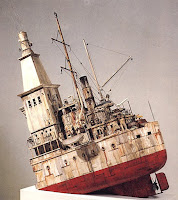
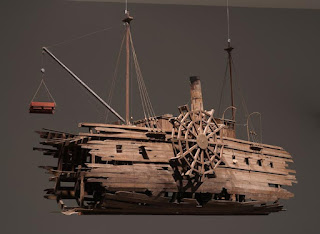
Southern California artist, Michael C. McMillen is an engineer of space and a visual commentator on the passage of time. Hailing from UCLA he began with works on paper and painting, but soon realized that those media were not adequate enough for his means.
His sculptures, installations and films are multi-sensory experiences momentarily enveloping and transporting the viewer from their present realities.

Early sculptures as well as work recently on view at LA Louver Gallery are architectural hybrids or transportation devices that seem to have had their day. The vessels especially evoke the passing of time and of decay. These machines were once on the cutting edge of technology, markers of the new, modern advances of man. However, as time passes the cutting edge becomes mundane, common place, and sometimes slips into the realm of the obsolete.


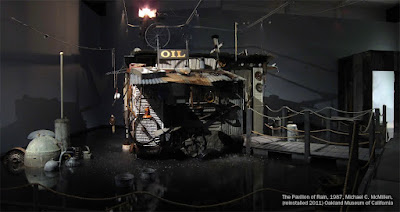
Now on view at the Oakland Museum of California, McMillen's artwork from the last 40 years is available to see for the first time as a complete exhibition. The exhibition includes drawing, painting, sculpture, film, as well as two large scale installations, The
Pavilion of Rain, first installed in 1987, and Lighthouse, a more recent work.

Pavilion of Rain, 1987

On the eve of this important retrospective, Mr. McMillen takes a moment to answer some general questions about himself and his work.

What is your birthday and where did you grow up?

I was born in Los Angeles in 1946 and grew up in Santa Monica when it was still a blue-collar town. Lots of light manufacturing, the aerospace industry and motion picture production were big employers at the time.


What are some of your major influences or inspirations?

I initially wanted to be a scientist or inventor so followed that path into college but at a critical point had an epiphany that what I really wanted to do was to invent experiences, to tell stories in effect through the medium of art. Both of my parents were artists, so I grew up surrounded with the materials of the craft. Drawing was a common language that I learned along with writing.


What drew you to sculpture and installation art specifically?

Although I love to paint and draw, I found that three dimensional work allowed me to address more senses than a painting allowed me to. Also, I really love the physical elements of construction. In recent years I have utilized film making as a way to introduce a time based element into my work. I utilize sight, texture, scale, sound, smell and movement to transport the viewer out of their 'comfort zone' and into unexpected settings and situations. A new way of seeing, a sort of time travel.


What gives you ideas for your work? How does a new project evolve?

The ideas are constantly flowing through my head. To state the obvious, we are all affected by our time and history- but it is out of this inescapable milieu that I find the situations, stories and paradoxes that I want to share and present. A project can start with a word, phrase, image, or concept- each one is different.


Can you tell me a little bit about your working process?

My working process is fairly simple. I design the work to utilize available materials when possible. It is a combination of fabrication and assemblage work which, if done properly, produces a seamless experience for the viewer. The viewer is the last element in the process as it is they who must experience the work and finish the equation with their unique response to the object/experience. My narratives are open and are not locked into a single reading.

____________________________________

In conjunction with the exhibition, a comprehensive catalog has been published by the museum in association with DelMonico Books, Prestel Publishing, New York.

Oakland Museum of California website

Friday, March 11, 2011

Bryan Baker, Printmaker

Named for constellations, Bryan Baker's new series of limited edition prints are intricately designed patterns made from dice on Vandercook presses.


Enthralling designs in vibrant color, almost exclusively in the red family.


And the technical details are precisely executed.


Byan is originally from Ohio. He went to school at the University of Tennessee in Knoxville and worked at Yee Haw Industries.
He currently lives and works in Brooklyn, New York, where he teaches printmaking classes at the arm in Williamsburg. He can also be found doing workshops at the Center for Book Arts.

www.bryanchristopherbaker.com
available for purchase here

Monday, January 3, 2011

Monday, December 13, 2010

Charles LeDray: workworkworkworkwork At the Whitney Museum of American Art (Nov. 2010 - Feb. 2011)


workworkworkworkwork is a retrospective exhibition that brings together numerous bodies of work by New York artist Charles LeDray. Master miniaturist, LeDray, has spent the last two decades creating an arsenal of intricately crafted, everyday objects on a very small scale. The title of the show refers to an earlier project. In 1991, after creating a trove of handmade miniature items like clothing, magazines, books and many other household items, LeDray displayed the work on a Manhattan sidewalk. He presented the items randomly, like someone’s possessions in a sidewalk sale. The work on view at the Whitney Museum also includes hand-stitched clothing, paperback books, and daily objects, as well as wheel-thrown tiny ceramics and meticulously carved human bone sculptures such as buttons or furniture. The featurepresentation of the exhibition is the artist’s most recent work, Men’s Suits, (2006-2009), an installation of three vignettes of second hand shops.

Upon entry into the exhibition the viewer confronts Village People (2003-2006), little hats of all kinds lining the length of the wall, high above eye level. All kinds of hats in miniature are represented such as the sombrero, cowboy, safari, or Indian headdress. These hats obviously refer to the different roles we play in our lives. Our identities become presented through such roles, developed through our professions, interests, or responsibilities.

Not all, but most, of LeDray’s works are experiments with men’s clothing. Lining the gallery walls are miniature outfits, suits, and uniforms, tailored to perfection. But this is not a fashion show. Surprisingly, LeDray never had formal training. He learned to sew from his mother as a child. The work he creates is scaled down, perhaps so the objects are not mistaken for commodities, but, instead, are subjects for introspection. The clothing we wear is the way inwhich we present and protect ourselves in the world. These works serve as substitutes for human presence, almost breathing on their own. Clothes that have been through life do not stay pristine. LeDray’s articles of clothing show such signs of life as tatters, stains, holes, missing buttons, and patched denim. Much of the work is quite literal, while other clothes are wittily or humorously abstracted or altered.

The series Men’s Suits (2006-2009), is a presentation of three small-scale scenes of second-hand clothing shops. One scene presents what looks like the back room of a store with hangers, laundry bags, a ladder and piles of clothes in disarray. The second is a public second hand or vintage shop, fully stocked, with coats, jackets, pants, shirts, gloves, belts and more. The third is a specialty section of a men’s shop, featuring an array of tiny ties, each a different pattern, from paisley to plaid. For this project LeDray spent three years painstakingly hand sewing miniature suits, shirts, and accessories, as well as crafting furniture, clothes hangers, laundry bags and shopping carts. The work is astounding in its realism. The miniature adult clothes are small - too small for any real person to wear - but they are not so small to seem like toys. The fabrics are not cheap and flimsy like doll’s clothes. One can tell that the materials have been carefully chosen, cut from real clothes. Small and wonderful, the work is delightful, but not necessarily cute. Blue jeans and jackets look worn, as if real life had been carried out in them. The vignettes are startlingly believable, causing a suspension of disbelief. One wonders about the lives of people who might have worn these clothes or who might choose to purchase them. This sensation is reminiscent of visiting preserved historical places, such as Versailles, Monticello, or the Anne Frank house, as they manage to transport the viewer to the environment and give a realistic sense of the lives that were lived there. This sensation, however, is momentary. The viewer is not completely enveloped, but towers above the scenes. One quickly returns to reality and the vignettes begin to feel like oversized dioramas.


These installations give an eerie perspective into human experience and our everyday lives. First, the scale (about one–third the scale of actual life) evokes the loneliness of knowing how small our lives are in comparison to the immensity of the universe. Second, one cannot help but feel a sense of futility. These coats, gloves, pants and collared shirts are so perfectly made, but no one will ever actually get the pleasure of wearing them. One thinks of the hours spent toiling away - planning, cutting, folding, ironing, and stitching…stitching…stitching. It brings to mind the hours and hours we all spend at work, or school, or on hobbies or projects - the labors of love and necessity. But when a task is complete, then what? It’s done – on to the next thing. One cannot help but sometimes wonder, what is it all for?

Wonder and disbelief are heightened when viewing Charles LeDray’s intricate ceramics. Presented in 6-7 ft. tall multi-tiered vitrines Throwing Shadows and Milk and Honey show thousands of delicate, porcelain vessels. The shapes of the vessels vary greatly and no form is spared. There are amphoras, urns, decanters, carafes, jugs, bowls, etc. One wonders what these tiny containers hold. Are they vessels for the hopes and dreams of the living or little reliquaries for something lost?

Lastly, there are the sculptures, such as an ivory finger bone with a gold wedding band or stacked furniture, carved from human bone. Again these inspire feelings of loss or futility. These types of objects may be the most morbid in his oeuvre, yet they do not fail to fascinate.

Witty and humorous, though often melancholy, the work is a delight. Though we are mortal, the gift of life is for living. Each person finds meaning in their own way, through how they choose to live and spend their time. One must do something to keep busy and Charles LeDray’s hands have not been idle. He has created an entire tiny universe of objects that manages to give grand insight into real human experience.

Thursday, October 28, 2010

Venezia


Giovanni Canaletto

Giovanni Canaletto


Gaspar Vanvitelli


Francesco Guardi

Francesco Guardi