Thursday, June 12, 2008
Thursday, March 20, 2008
Spring

August Sander
Group of Children, Westerwald, 1913

Helen Levitt
New York, circa 1940
'Bruce Davidson
Untitled, 1960

Christer Stromholm
Paris, 1962

Pablo Ortiz Monasterio
Socios, 1987
Monday, March 17, 2008
Identity Crisis
Who am I? What does it mean to be me? How is my experience different from or similar to yours?
In answer to this in my own way I wanted to know what it means to be a person in the world, so I studied cultural anthropology as well as sociology in college. Mostly, there was a lot of discussion about what culture is.
Culture (from the latin cultura stemming from colere, meaning "to cultivate,") generally refers to patterns of human activity and the symbolic structures and systems that give activities meaning. Often even the creators contest the meanings of such systems, which tend to lack fixed boundaries and are constantly in flux.
So, people constantly create and recreate themselves and this seems to be reflected in individuals and groups alike.
Culture is manifested in such things as language, style of dress, eating practices, celebrations, arts, science, as well as political and religious systems.
Essentially, what I came away with upon leaving college was the overwhelming sense of the human condition. A life on earth as a human persists to be just as heavy as it ever has been in the past, regardless of any agricultural, technological, or scientific advances. Though life is lived and perceived differently from whatever perspective one is given at birth, ie: time period, location, economic status etc., each person is born with the same guts and emotions as anyone else. We all need to come to terms with our individuality and sort out the feelings surrounding the loneliness of mortality. We also need the comfort and safety of identifying with and interacting with others.
What makes the human condition so utterly overwhelming and amazing is the expanse of possible permutations of the experience of a lifetime on earth.
Cultural anthropologists tend to use the term culture most often to refer to the universal human method of classifying and communicating experiences symbolically - which is also what art is all about.
___________________________________________________________
Here are some artists who explore concepts of identity in their work.Claude Cahun


various images, circa 1930s
Claude Cahun was a French artist, poet, playright, activist et al. who often used photography in her exploration of concepts of gender and sexuality.
One non-photographic, but very compelling body of work was a series, called Heroines, of which she would perform monologues based upon female literary or mythic characters. Her characters included Sappho, The Virgin Mary, Helen of Troy, Eve, and Salome. She would combine such iconic characters with the contemporary image of women of the day. The result produced a social commentary on the portrayals of identity and sexuality.
Cindy Sherman
Untitled Film Still #21, 1978
Since the 1970s Cindy Sherman has continued to explore identity roles. In my opinion her work has never topped her Untitled Film Stills taken from 1977-79.
Tomoko Sawada

Tomoko Sawada is a contemporary artist from Japan who has done a number of photographic series in which she is the sole subject, playing various roles. (ie: ID400, School Days and Omiai) She explores the concept of one's own identity, exemplifying the numerous characters one person could create by merely altering their appearance. Her work, especially ID400, stirs up questions of what it means to be an individual in this age of overwhelming population, ever growing urban centers, and where the mass media is a persistent force.
Nikki S. Lee
Skateboarders Project (14), 2000

Seniors Project (14), 1999

Hispanic Project (11), 1998
Nikki S. Lee is a Korean born artist who has two well known series, Projects and Parts. Projects is her first body of work, in which she explores identity by adopting the personae of various subcutures.
In her conversation with Gilbert Vicario in her book, Projects, (Hatje Cantz, 2001), she says "Changing myself is part of my identity. That's never changed. I'm just playing with forms of changing. My work is really simple, actually. I wanted to make evidence as John Berger calls it. I always feel like I have a lot of different characters inside ands I was curious to understand these things. I wanted to se some sort of evidence that I could be all those different things."
Tuesday, December 11, 2007
Twins

Louis Faurer, Twin Sisters, New York, 1948
I think I am particularly fascinated by twins for two reasons:
One.) My mother is one of a pair of fraternal twins. Mom is Carol. My aunt is Cheryl. Cute names were a trend in post WWII baby booming America.
Here they are at age 12
From what I have gathered about being a twin is that the part that seems to be problematic is that one's particular identity is sometimes uncomfortably overshadowed by the phenomenon of the pair.
Another thing about my mother's being a twin...there is a possibility of myself bearing twins in the future.
Two.) My astrological sign is Gemini.
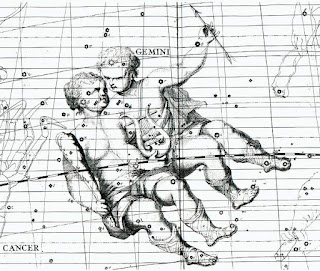
The astrological sign of gemini gets its name from Greek and Roman mythology. Kastor and Polydeuces (Castor and Pollux) are twin sons of Leda. Leda was their mother, who had been seduced by Zeus while he was in the form of a swan. Zeus then became the children's "divine" father, while the twins went on to live with a "foster," mortal, father, Tyndareus.
The interesting part about the detail of the fathers is that in the stories about the twins, they are inconsistently referred to as divine and/or mortal.
Therefore, twins are often cast as the symbolic representation of duality.

Diane Arbus, Identical Twins

Disfarmer, Untitled, Heber Springs Arkansas, circa 1940s
Since ancient times in religions and philosophies all over the world, dualisms in life have been major sources of inquiry, thought, and debate.
Common dualities include :
Mortal / Divine
Sacred / Secular
Physical / Mental
Emotional / Logical
Reason / Passion
Nature / Nurture
Body / Soul
____________________________________
Where is the line between the body and the mind?
Where the body is a collection of organic and physical elements, chemicals and sensory systems, the mind is one's internalization of environment and circumstances into consciousness, awareness, and creation.

Joaquin Trujillo, from the series, Los Ninos
How do two individuals, borne from the same substance, live in, react to, and understand the world differently?
Thursday, November 15, 2007
Mapping
I am very interested in maps. I love them.
I understand them and I make them.
I especially like how maps can be very organic, sometimes resembling root systems of plants or the veins of a human body.
Maps are also an expression of a particular point of view. In this case maps can be works of art as they are just another avenue of interpreting the world. In an episode called Mapping of This American Life, Ira Glass says, "Every map is the world seen through the filter of a different lense." Like a photograph the composition of a map may be documentary, scientific, aesthetic or poetic. They can also be altered to tell a story or express an opinion.
I have in the past year been working on a nine foot timeline/map of history of which I will divulge no more details at this time.
Until then, here are some artists I have found that are making maps:
Paula Scher

Manhattan

Manhattan (detail)

Tsunami
See more at Maya Stendhal Gallery
Nina Katchadourian

World Map, 1989

Coastal Merger, 1993
Look very closely.
Nina Kathchadouorian reassembles paper maps to create new and witty constructions.
Also see more here: Geographical Pathologies
Dennis Wood
is a cartographer that I heard on This American Life's recent show called Mapping(listen free).
He did a project where he extensively mapped his neighborhood of Boylan Heights in Raleigh, North Carolina.
Boylan Power is a map of the neighborhood’s phone, cable, and power lines.
Thursday, November 1, 2007
Photographs of Jeff Charbonneau & Eliza French


View their wesite
Artwork can be seen at Robert Berman Gallery, Bergamot Station, Santa Monica
Thursday, October 25, 2007
Neil Farber

Untitled, 2005
In Neil Farber's artwork, one will most often find the repeated motif of a black haired male figure. These repeated figures seem to represent the human condition as an anonymous experience with the goods and bads of life sparing no one.
I am reminded of an image that was on the wall of my childhood home for years and years. It is an image of an acrylic painting by Mark Sabin.

Mark Sabin
Rush Hour, 1979
Though Sabin's piece focuses more definitively upon business men crowded into the streets of New York City, the feeling is similar. The viewer is situated in the midst of an anonymous crowd. Though surrounded by people, one feels isolated and alone.
The repeated male figure is sometimes a Dracula (see below). This is at once hilarious while simultaneously creepy. These denote a somewhat sinister view; that perhaps of a capitalist society where the business-suited individuals are frowning, bloodsucking monsters, only out for their own gain.

Untitled, 2005
The multiplicity of the black-haired male in so many of Farber's compositions may be a reference to our modern, technological age. An age in which there is an explosion of population and where distances between peoples are rapidly shortening. People are crowding into cities and becoming reliant on technology, but somehow there is a vast sense among individuals of isolation and depression. Be it to technology, expansion, exploitation, or trade, there is a shrinking of differentiation between peoples and cultures around the world, which seems as though it can only lead to very nefarious ends.

Untitled, 2005
All images copyright the artist.
| Don't Miss It: Neil Farber |
| New Works |
| at Richard Heller Gallery |
| January 5, 2008 - February, 2 2008 |
| Opening Reception: 5 - 7 pm |
Saturday, October 20, 2007
The Strange and Beautiful World of Amy Cutler

Saddlebacked, 2002
I would like to write today to bring some attention to the artist Amy Cutler. I first came across her when I found Lisa D. Freiman's book (Hatje Cantz, 2006) and immediately I was fascinated. Something about her artwork is so alluring. It must be the combination of the artist's brilliant attention to detail and the peculiar and confounding predicaments the characters find themselves in.
Her characters, all female, are confronted with situations in which they are physically bound to any number of scenarios. Any daily task, whether it be ironing, tending to chickens, or having a dinner party, becomes confounded by the fact that for those involved, one becomes a physical part of any action. The line is blurred about whether the woman or the task at hand is in control. Campers are wearing skirts that are the tents; A face is a potential birdhouse for dozens of birds; Fist fighting schoolgirls are entwined by their hair, as if they are conjoined twins from their braids' growth into one another.
Cutler's precisely drawn lines and bright colors aid in illustrating a sense of whimsy. This is heightened by the fine attention to fashion, focusing on traditional and earlier styles of dress.
Whimsey contrasts with an eerie surrealism as one clearly sees the futility or ridiculousness of a given predicament.
The characters' impossible situations are almost real enough to feel and one can momentarily share in sensations of anger, frustration, or melancholy. Meanwhile, the details and colors are delightful and the compositions leave you entranced.

Sweepers, 2001
See more HERE.


